
Lawn, Artificial Grass Or Meadow? Choosing For A St Albans Garden
Superior Garden Design St Albans
This summer settled an argument for a lot of people in St Albans. From 17 July 2026 Affinity Water banned hosepipe use on gardens across its Central region, every AL postcode from AL1 to AL10 included, and within a fortnight the lawns along most streets had gone the colour of toast. Some neighbours took it as proof that grass is finished and started pricing artificial turf. Others let theirs grow long and found it full of clover and bees. Both had a point. Neither had the whole picture. When we’re asked whether a garden should have a lawn, artificial grass or a meadow, our answer depends on five things: the soil, the shade, who uses the space, how much water you can count on, and how much the surface will cost you every year after it goes in. Below is how each one fares against each of those in this part of Hertfordshire. Most of the gardens we design end up with more than one.
Lawn, artificial grass or meadow: start with the ground in St Albans
St Albans sits on two quite different soils, often within the same street. On the higher ground the chalk is capped with clay-with-flints: heavy, sticky in winter, rock hard by July, and packed with flints that keep working up to the surface. Down the slopes towards the Ver the cap thins out and you’re on chalk, where the topsoil can be a spade deep or less and dries out within days of rain.
Each surface reacts to those soils differently. A lawn on clay-with-flints stays green longer into a dry spell than one on chalk, because the clay holds water, but it compacts easily and turns to mud in a wet February. On chalk the same lawn drains beautifully and browns early. Artificial grass doesn’t care about drought, but it cares a great deal about drainage: lay it over undisturbed clay and rainwater, or dog urine, sits in the sub-base with nowhere to go. A meadow is the other way round. It grows best on poor, free-draining ground, so thin chalk soil suits it far better than fertile clay.
That’s why every garden landscaping project we take on starts with a few trial holes before anyone chooses a surface. Twenty minutes with a spade tells you more than any brochure.
What the 2026 hosepipe ban changes for a lawn
Affinity Water’s notice came into force at one minute past midnight on 17 July and stays in place until the company publishes another one lifting it. Under the ban you can’t use a hosepipe on a garden or a lawn. Watering cans, buckets and water from a butt are all still fine, and the full list of exceptions is on Affinity Water’s temporary use ban page. A few details in it matter if you’re deciding what to put down.
New turf gets a short reprieve. You may hose turf laid before the ban began, for four weeks from the day it was laid. Turf laid during a ban gets no such allowance, so a spring or early autumn turfing job is much safer than one in June. Drip irrigation is also allowed, as long as it has a pressure-reducing valve and a timer and puts the water straight onto or under the soil. Sprinklers are not allowed. That rules out the usual way of keeping a big lawn green. Then there’s the one people miss: the ban also covers cleaning “artificial outdoor surfaces” with a hosepipe. If your plan for a dog run on artificial grass was a quick hose-down every evening, that plan fails in exactly the summers you’d need it.
The good news about real grass is that browning is not death. The RHS’s advice on lawn care in drought is to raise the mower, leave the clippings and let the lawn go dormant, because established turf greens up again once the autumn rain arrives. Most of the brown lawns in the city this summer were green again by the end of September. If a lawn that can brown off for six weeks without anyone panicking sounds acceptable, it’s still a good choice here. For the planting side of a dry summer, our guide to designing a St Albans garden for dry summers goes further.
Shade from mature trees, where none of the three does well
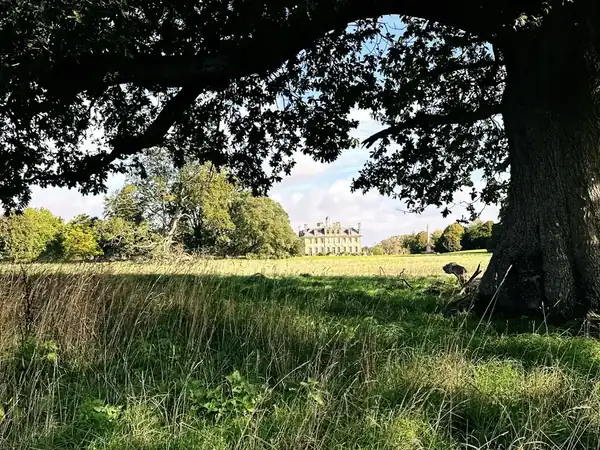
A lot of gardens here have a big oak, beech or sycamore either in them or leaning over from next door. Under a full canopy none of the three surfaces works well, and it’s better to know that before you spend money.
Grass needs a decent share of direct sun, and under a tree it’s also competing with roots for every drop of water in summer. The result is thin, mossy turf that looks worst exactly where you’d like to sit in the shade. Shade-tolerant seed mixes based on fine fescues help under light, dappled cover. They won’t help under a dense, low canopy. Artificial grass seems to solve this, but trees drop leaves, seeds, sap and bird mess onto it all year. The debris rots into the pile, moss and algae grow on the backing, and you spend autumn with a leaf blower. A meadow wants an open, sunny site too, and most native wildflowers flower poorly in shade.
What works under a tree is planting rather than any kind of grass: ferns, epimediums, hardy geraniums and spring bulbs, with a bark or gravel path through them. Sometimes a strip of rough grass at the edge of the canopy, cut a couple of times a year, gives you the look of a woodland glade without asking a lawn to cope in the deepest shade.
Artificial grass in a St Albans garden: heat, plastic and the sub-base
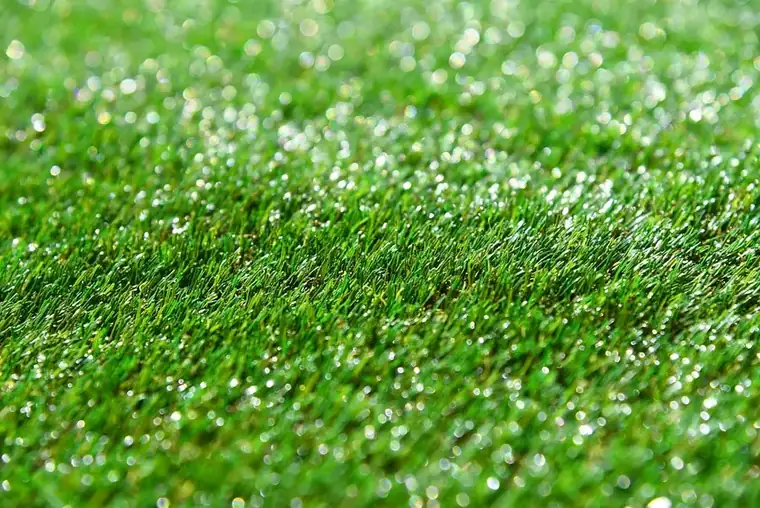
We do fit artificial grass, mostly for small shaded courtyards and roof terraces, so this is not a lecture. But there are three things the sales leaflets tend to leave out.
The first is heat. Plastic fibres soak up sunshine, and on a hot afternoon the surface can be far hotter than the air. Researchers measuring synthetic sports pitches have recorded surface temperatures above 60°C on sunny summer days, far hotter than real grass alongside. Garden turf uses the same kind of plastic, and that’s hot enough to keep bare feet and paws off it, and a south-facing back garden in Fleetville or Marshalswick gets plenty of those afternoons now. A real lawn, even a brown one, stays much cooler.
The second is what it’s made of. The pile is polyethylene or polypropylene. As it wears and weathers it sheds fibre fragments into the soil and the drains, and when it reaches the end of its life, usually after ten to fifteen years, the backing and pile are hard to separate and recycle. The RHS no longer allows plastic grass at its shows for broadly these reasons. None of that makes it wrong in every case, but it belongs on the scales next to the convenience.
The third is the ground beneath it. Done properly, artificial grass sits on a dug-out base of crushed stone and sharp sand that lets water through. On clay-with-flints that base needs somewhere to drain, otherwise water collects under the membrane and pet urine collects with it. A cheap install skips this, and that’s why some artificial lawns smell by their second summer.
A wildflower meadow is easier on chalk than on clay
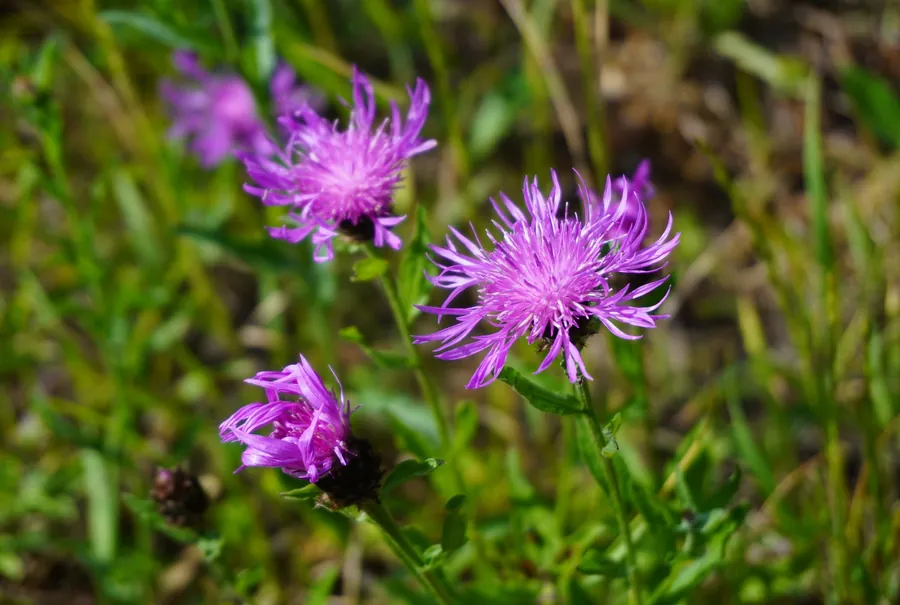
Chalk grassland is one of the richest wildflower habitats in the country, and much of St Albans is built on the same rock. Knapweed, bird’s-foot trefoil, wild marjoram, field scabious and ox-eye daisy all do well on thin, limey soil where vigorous grasses struggle. On a garden with only a few inches of topsoil over chalk, a meadow is the easy option.
Clay is harder going. Rich, moisture-holding soil feeds coarse grasses, which crowd out the flowers within a couple of seasons. On clay we either strip the turf and top few inches of soil before sowing, or start more gently by converting an existing lawn: let it grow, sow yellow rattle in autumn to weaken the grass, then plug in wildflowers. The RHS sets out these routes in its guide to creating wildflower meadows.
You don’t have to commit to a full meadow to see the benefit. Plantlife’s No Mow May campaign has found more than 250 plant species flowering on ordinary garden lawns once people stopped mowing, and found that cutting short grass about once every four weeks, instead of weekly, gives far more nectar from daisies, clover and selfheal. A meadow does need a hard cut in late summer, with the cuttings raked off so they don’t feed the soil, and from August to September it looks like hay. If you can live with that, it costs less to run than anything else here.
Children, dogs and what each surface costs
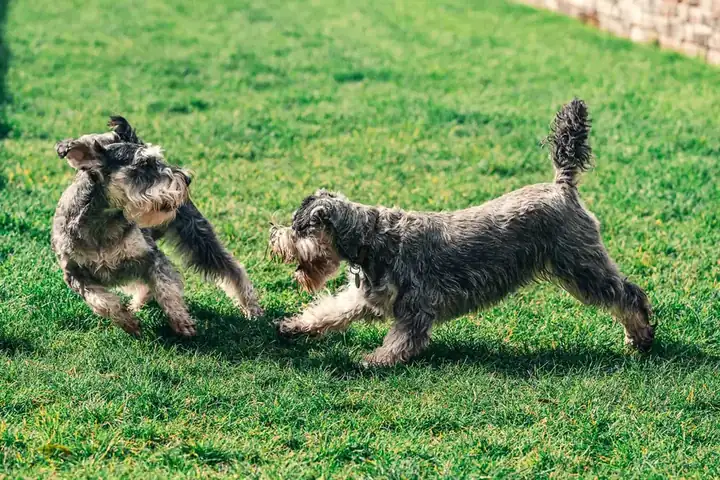
For a family garden, wear matters as much as looks. A lawn sown or turfed with a hard-wearing ryegrass mix copes with football, a trampoline moved every few weeks and children sliding on their knees, and it repairs itself. Dogs leave yellow patches where they wee, but you can reseed those. Artificial grass handles heavy foot traffic and never turns to mud, which is why parents with a small, wet garden like it. It’s also hot in summer and gives friction burns, and with dogs it has to be cleaned regularly. A meadow isn’t for playing on at all. It sits beside the play area, not in place of it.
Here are rough 2026 prices we see around St Albans, for a level site without major groundwork:
| Installed cost | Yearly running | Lifespan | |
|---|---|---|---|
| New lawn from turf | £25 to £45 per m² | Mowing, a feed, autumn scarifying; £250 to £450 a year if you pay a lawn care firm | Indefinite with care |
| New lawn from seed | £10 to £20 per m² | As above | Indefinite with care |
| Artificial grass | £70 to £120 per m² with a proper sub-base | Brushing, leaf clearing, infill top-ups, pet cleaner | 10 to 15 years, then replace |
| Meadow (lawn converted) | A few hundred pounds in seed and plug plants | One or two cuts a year, cuttings removed | Indefinite, improves with age |
| Meadow (sown on stripped ground) | £15 to £30 per m² | As above | Indefinite |
Artificial grass looks expensive at the start and the cost comes round again: in ten to fifteen years you pay for removal, disposal and new turf. A lawn costs very little to put in and a steady amount every year after. A meadow is cheap both ways, but it’s the slowest to look good, taking a couple of seasons. Our piece on low-maintenance garden design in St Albans looks at how those yearly hours add up across the rest of the garden.
How we combine lawn, meadow and artificial grass in one St Albans garden
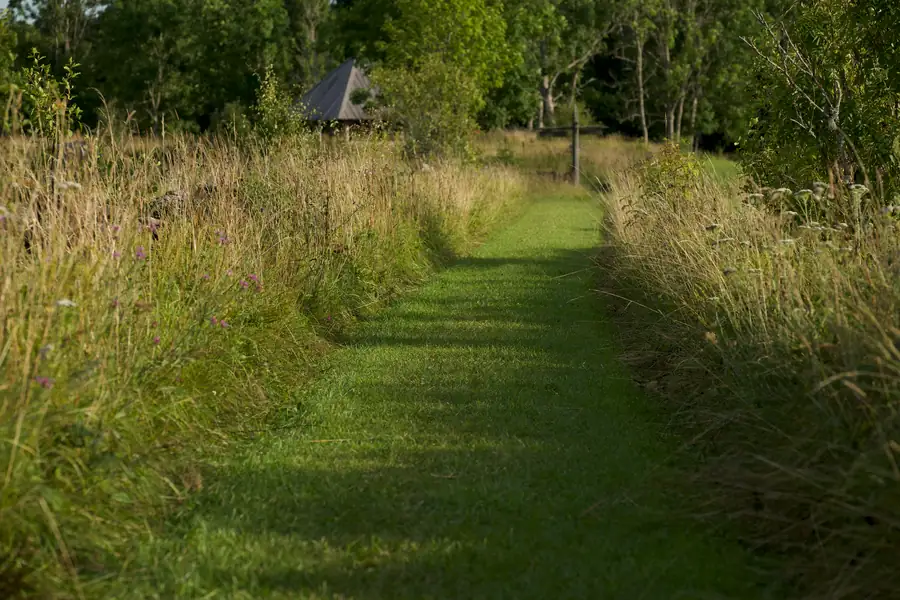
Very few of the gardens we draw use one surface from fence to fence. A typical layout for a long St Albans plot might look like this. A rectangle of hard-wearing lawn sits nearest the house, sized for the children or the dog and edged with brick or steel so the mower runs straight over the edge. Beyond it, longer grass with bulbs and wildflowers takes over towards the end of the garden, cut once in late summer. A mown path, a mower’s width or two, runs through the long grass to a bench or a studio. It looks deliberate, and it tells the neighbours the long grass is on purpose.
Artificial grass, if we use it at all, goes where nothing living would cope: a deeply shaded side return, a balcony, or a small patch under a play frame where real grass would be worn bare by June. Even there we’ll often suggest bark chip or rubber mulch instead.
The practical upshot shows up in a dry year. When the next ban lands, the only thing needing a watering can is the bit of lawn by the back door.
Common questions
Can I water a new lawn during an Affinity Water hosepipe ban?
Only if the turf was laid before the ban started, and then for four weeks from the day it was laid. Turf laid during a ban has to be watered by can or with water from a butt. Drip irrigation with a pressure-reducing valve and a timer is allowed, but sprinklers are not.
Is artificial grass a good idea if I have a dog?
It can work, but it needs a free-draining sub-base, especially on clay, and regular rinsing with an enzyme cleaner to stop smells. Under a hosepipe ban you can’t hose it down, so you’d be using buckets. A tough real lawn with the odd reseeded patch is often easier to live with.
How long does a wildflower meadow take to establish on chalk?
On thin chalk soil a sown perennial meadow usually gives a decent show in its second summer and keeps improving for several years after that. On clay it takes longer, and it helps to strip the fertile topsoil or use yellow rattle to weaken the grass first.
Will a brown lawn recover after a dry summer?
Almost always. Established grass goes dormant in drought and greens up again once autumn rain returns. Raise the mower blade, leave the clippings on the lawn and avoid feeding it until it’s growing again. Reseed any patches still bare by mid-autumn.
Talk to us about the right mix of lawn, meadow and planting for your St Albans garden