
Designing A St Albans Garden For Dry Summers
Superior Garden Design St Albans
Ask people to describe the British climate and they will say rain. Ask them to describe last August and they will say the lawn went brown in the first week and never came back. Both are true, and the gap between them is where a lot of Hertfordshire gardens fail. This corner of England gets roughly 600 to 650mm of rain a year, a little over half the UK average, and most of it arrives in the months when plants are asleep. Meanwhile the region is officially classed as seriously water stressed, we garden on ground that either bakes solid or drains like a colander, and summer restrictions on hosepipes are now a recurring feature of the calendar rather than a freak event. None of that means a dusty gravel garden is your only option. It means the water strategy has to be designed in at the start, alongside the levels and the layout, rather than bolted on with a sprinkler in July.
Hertfordshire runs dry earlier than most of England
The rain shadow of the country runs down the eastern side, and we sit in it. St Albans is drier than Bristol, considerably drier than Manchester, and closer in annual rainfall to parts of southern France than most residents realise. On its own that would be manageable. Population is what sharpens it. This is one of the most densely populated water resource zones in the country, drawing on the same aquifer that supplies London’s northern fringe. The government’s water stressed areas classification puts our supply region in the most serious category, which is the formal way of saying demand and supply are uncomfortably close together.
For garden design the practical consequence is a planning assumption. Assume you will not be watering freely in July or August, at least not with a hose, and design a garden that does not need you to. Everything below follows from that one decision, and it is far easier to make on paper than to retrofit into a finished planting design.
What the chalk underneath does with the rain
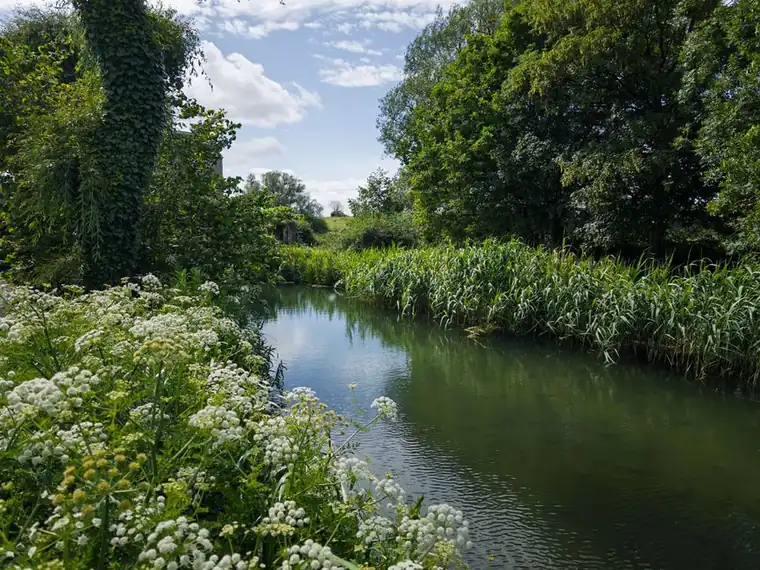
Under most of this district sits chalk, and chalk is a sponge with a hole in the bottom. Rain moves through it into the aquifer rather than running off, which is why the Ver runs clear rather than brown, and why the ground above thin chalk soils can be dust two weeks after heavy rain. Where the clay-with-flints cap survives on the higher ground, the opposite problem appears: water sits on the surface in winter and the same soil sets like fired pottery by August.
Both soils punish the same design mistake, which is planting things that expect steady, moderate moisture. Neither soil offers it. The chalk gives you drought with good drainage; the clay gives you drought with terrible structure. Knowing which one you have changes the plant list completely, and it is worth ten minutes with a spade before any design work starts - our guide to clay and chalk soils in St Albans covers how to tell them apart.
Soil is the cheapest irrigation you will ever buy
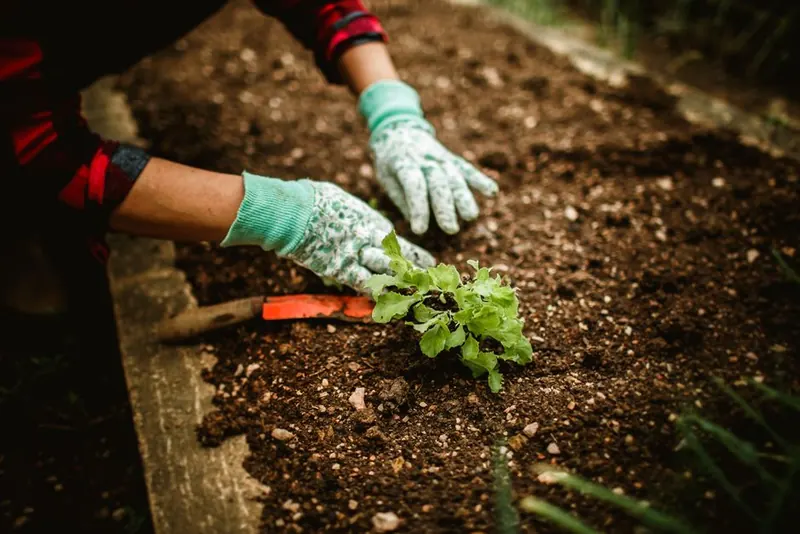
Before anyone spends money on watering systems, the money should go into organic matter. A soil with good structure holds water in the pores between crumbs and releases it slowly; a compacted or depleted soil either sheds it or locks it away. On clay, bulky compost opens the structure so roots can go deep enough to find moisture in a dry spell. On thin chalk, it adds the water-holding capacity the soil simply does not have.
Then mulch, and mulch properly. A 50 to 75mm layer of composted bark or well-rotted green waste over damp soil cuts evaporation from the surface dramatically and suppresses the weeds that would otherwise drink your water for you. Do it in early spring while the ground is still wet, never onto dry soil, and keep it off plant stems.
The one-off cost of improving a border is usually a few hundred pounds. Installing and running an irrigation system to compensate for not doing it costs more every year, forever. That is the order of operations most people get backwards.
The lawn is the biggest water decision you will make

Nothing else in a typical garden comes close to the lawn for water demand. A uniformly green, striped sward through a Hertfordshire August is an irrigated crop. It is worth deciding on purpose whether you want to farm one.
There are three honest positions. Keep the lawn and accept it browning, which does no lasting harm to established turf - it goes dormant and recovers with the autumn rain. Keep a smaller lawn, sized to how the family actually uses it, and give the reclaimed space to planting that needs no water once established. Or replace part of it with something else entirely: a gravel terrace, a wildflower area cut twice a year, a mown path through longer grass.
Of the projects we take on around the city, the reduced-lawn option is the one clients are most nervous about at the drawing stage and most pleased with two summers later. A lawn shrunk by a third usually looks bigger, because it gains a shape and an edge instead of just filling whatever space is left.
Catching what falls, and watering only what needs it
A modest roof sheds a genuinely useful volume of water in a wet winter, and most of it currently goes down a drain. Water butts on the house, the garage and any garden building are the crude version. The better version is designing the levels so surface water goes somewhere useful: a shallow planted depression that takes runoff from a terrace and lets it soak away slowly, which the RHS guidance on rain gardens sets out well, or permeable paving over a stone base that acts as a reservoir under your feet.
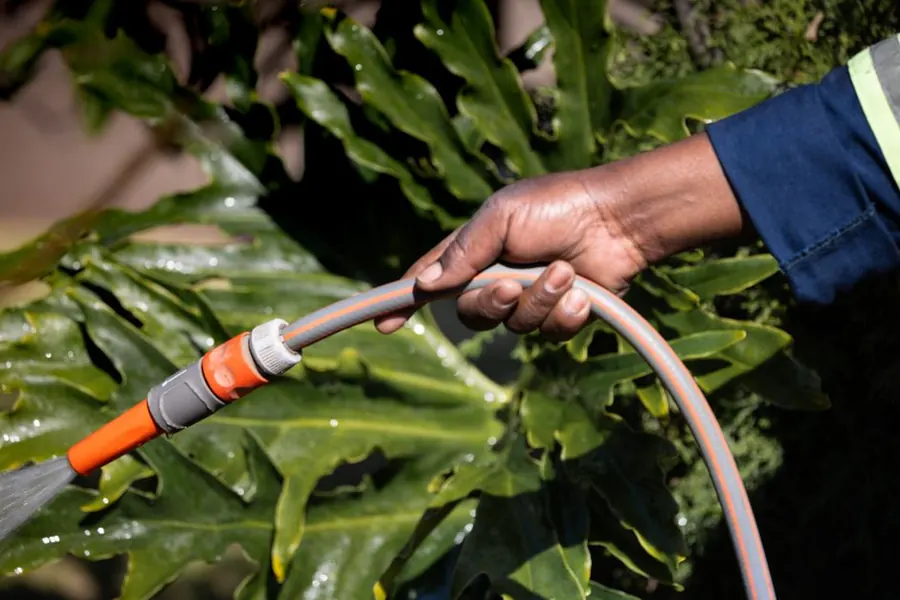
Where irrigation is justified, keep it narrow. Drip line under the mulch in new borders, a dedicated line to pots and any raised kitchen beds, and nothing at all to established planting after its second summer. Sprinklers spraying a whole garden at midday are the version worth avoiding: most of it evaporates, and it trains roots to stay near the surface where they are most vulnerable. Your supplier’s water saving advice is worth a read before you specify anything, since restrictions apply to garden watering first.
Planting that copes without looking like a car park

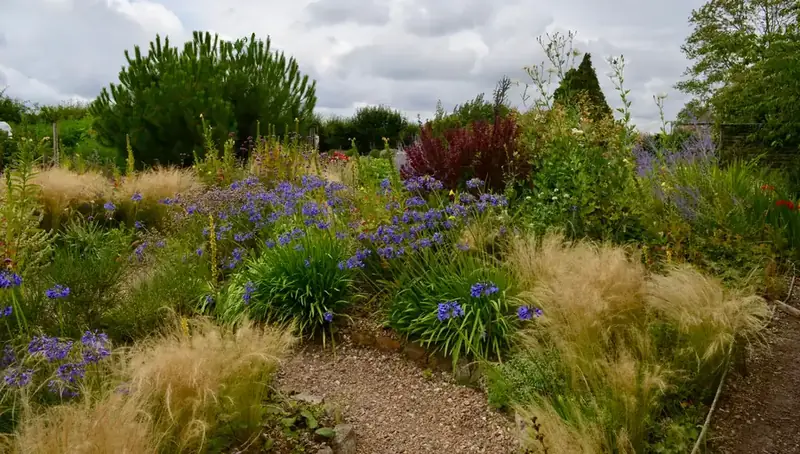
Drought-tolerant planting has an image problem, mostly earned in the 1990s by too much purple slate and too few plants. Done well it is the most generous-looking planting there is, because the plants that cope with dry summers tend to flower hard and long.
On chalk, silver and aromatic foliage does the work: lavender, santolina, phlomis, perovskia, euphorbia, alongside grasses like stipa and calamagrostis that move in the slightest wind. On clay, the palette shifts to deeper-rooting perennials that tolerate the summer set: echinops, achillea, sedum, hemerocallis, geranium, with shrubs like viburnum and amelanchier for structure.
Two rules make either palette work. Plant in autumn, not late spring, so roots establish through the wet months and face their first summer already anchored. And water new planting deeply and infrequently - a proper soak once a week beats a daily sprinkle every time, because it pulls roots downwards instead of encouraging them to loiter at the surface.
Common questions
Will a hosepipe ban stop us establishing a new garden?
Restrictions on garden watering are aimed at hoses and sprinklers, and a temporary use ban does not usually stop you carrying water in a can. That said, planting a big new scheme in June and hoping is a poor plan in this region regardless of restrictions. Autumn planting sidesteps the issue almost entirely, which is why we programme most planting between October and March.
Is artificial grass the sensible answer to a dry Hertfordshire summer?
It solves the brown-lawn problem and creates several others. Artificial turf gets uncomfortably hot in full sun, sheds microplastics, supports no soil life, and still needs a permeable base built properly or it holds water. For a small shaded courtyard it can make sense. For a family garden on chalk, reduced lawn plus better soil usually gives a nicer result for similar money.
How much water does a designed garden actually need once it is established?
Less than most people expect, if it was planned for the site. Borders planted with species suited to the soil should need no routine watering after their second summer, with pots and any productive beds being the ongoing exception. The gardens that need constant water are usually the ones planted from a wish list rather than a survey.