
Garden Drainage In St Albans: Designing For Clay-With-Flints And Chalk
Superior Garden Design St Albans
Ask a St Albans homeowner what is wrong with their garden in January and a surprising number say the same thing: the lawn squelches, the patio holds puddles for days and the bottom corner never really dries out. Then, by August, the same lawn has cracked. That swing comes from the ground. Much of the district has a skin of clay-with-flints sitting on chalk, and the clay decides how fast water leaves. A few figures run through everything below. Building regulations keep a soakaway at least 5 metres from a building. Paving wants a gradient of around 1 in 60 to 1 in 80 to shed rain properly. And a front garden paved with more than 5 square metres of a solid surface that drains onto the road needs planning permission. None of these is hard to design for. They get expensive when they are bolted on after the turf is down, so we sort out the water on the first drawing, not the last.
Why St Albans gardens hold water
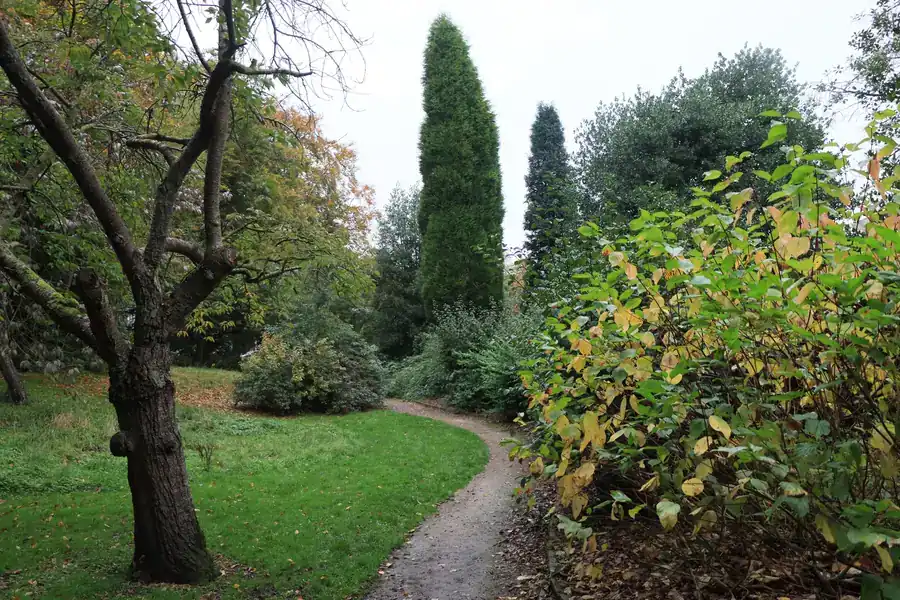
St Albans sits on the dip slope of the Chilterns, and the chalk underneath is the same rock that runs across most of Hertfordshire. On the higher ground, though, the chalk is capped by clay-with-flints: a reddish-brown, sticky clay full of broken flint, often only a few metres thick. Down in the Vale of St Albans you find a different mix again, with sands and gravels left by the ancient course of the Thames and patches of glacial clay. The British Geological Survey’s Geology Viewer lets you zoom to your own street and see which one you have.
The practical result is that two gardens a mile apart can behave in opposite ways. On clay, rain sits in the top layer because the fine particles leave almost no space for it to move through. A lawn that has been walked on, mown with a heavy machine or driven over by builders is worse, because compaction squeezes out the few air gaps left. On thin soil over chalk, water vanishes quickly, sometimes too quickly. Most of the problem gardens we see are the first kind, and many of them are new-build plots where the topsoil was stripped, the subsoil was tracked flat by diggers and a thin layer of turf was laid on top.
So drainage belongs in the design of the whole garden rather than being handed to a separate trade at the end, which is how we run every garden landscaping project. The levels, the paving, the planting and the pipes are one decision.
Read the garden in winter before drawing anything

The best drainage survey costs nothing. Walk the garden after two or three days of steady rain between November and February, and take photos. Where does water stand? How long does it stay? Is it the whole lawn, or a strip along the bottom fence where a neighbour’s garden drains into yours? Is the patio ponding against the back wall of the house? Those photos are worth more to a designer than any amount of description.
Then we dig. A trial hole about 300mm across and as deep as a spade and a half tells you what the topsoil is like, where the clay starts, and whether there is chalk or gravel within reach. If water seeps in and sits at the bottom of a fresh hole, the problem is a high or perched water table, not just a compacted surface, and the answer is very different. Surface compaction can often be fixed with aeration and organic matter, as the RHS advice on waterlogged lawns explains. Water that sits in the subsoil needs somewhere to go.
Falls, levels and paving that sheds rain
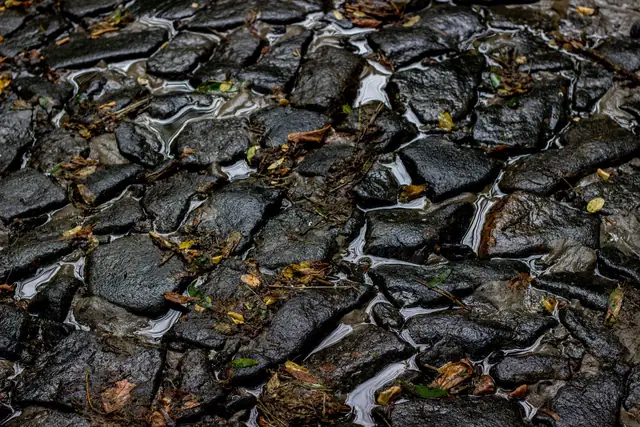
Most patios that puddle were laid flat, or laid with a fall towards the house. Water needs a slope it can feel. We work to roughly 1 in 60 on riven stone and something gentler, nearer 1 in 80, on smooth porcelain, and the slope always runs away from the building. Next to the house the finished paving stays two brick courses, about 150mm, below the damp course so that splash-back and standing water never reach the wall. On a level St Albans terrace that often means the paving outside the back door drops a step from the kitchen floor, and it is better to design that step in than discover it on site.
The bigger question is where the paving drains to. On clay, sending a terrace’s worth of rain onto the lawn just moves the bog a few metres further down the garden. The water wants a destination: a slot drain along the lowest edge feeding a pipe, a gravel strip in front of a planted bed, or a rain garden. Front gardens carry a planning rule on top. If you pave more than 5 square metres with a solid surface that runs onto the road, you need permission, while permeable block, gravel or a solid surface that drains into your own border does not. We went through the materials that meet that rule in our post on choosing paving for a St Albans garden.
French drains and land drains: only as good as their outlet

A French drain is a trench filled with clean stone, usually with a perforated pipe at the bottom wrapped in a geotextile so soil cannot clog it. It collects water from the surrounding ground and carries it along a slight fall, around 1 in 100, to a discharge point. On a sodden lawn the classic layout is a herringbone of narrow drains feeding a main run. Along the foot of a slope or a boundary, a single cut-off drain often does most of the work by catching the water before it reaches the lawn at all.
Here is the part that gets skipped. A land drain moves water; it does not make water disappear. If the pipe ends in a buried crate in the same clay, it fills and backs up, and in two winters the drain is blamed. Before we draw a French drain we decide its outlet: an existing surface-water connection where the property has one and it is permitted, a ditch or watercourse at the bottom of a larger plot, or a soakaway that has actually passed a test. Foul sewers are off limits for rainwater. If none of those options exists, the design changes to hold and slow water on the surface instead, which is where rain gardens come in.
Soakaways: why they fail on clay and when they work
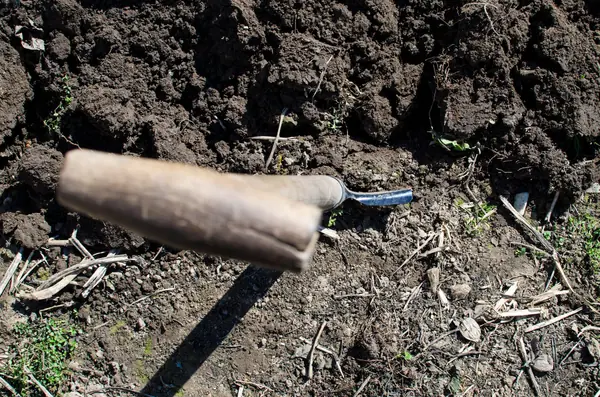
A soakaway is a pit or crate system that stores water and lets it seep slowly into the ground around it. That word “seep” is the whole issue. In clay-with-flints the seepage rate can be so low that the pit is still full from the last storm when the next one arrives. Building regulations guidance in Approved Document H on drainage and waste disposal sets the ground rules: a percolation test first, a soakaway kept at least 5 metres from any building, and not in unstable ground. For a small area of up to 25 square metres it suggests sizing for a heavy downpour of 10mm in five minutes.
A percolation test is not complicated. You dig a pit, fill it with water, let it drain and refill it to soak the ground, then time how long the level takes to fall. On clay plots around Marshalswick or the north side of the city, those times often run into many hours, and the honest conclusion is that a soakaway is the wrong tool. Where the clay thins and the chalk or the Vale gravels come within reach, the picture changes and a properly sized soakaway can work well. Even then we keep it well away from the house and from any footings. Concentrated water in chalk is not something you want next to a foundation.
Rain gardens and swales as part of the design
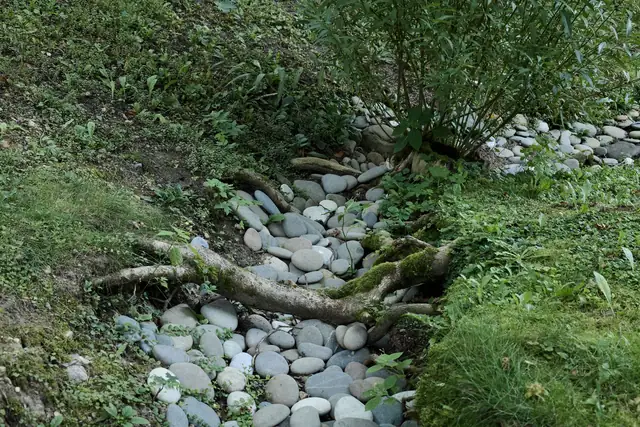
When water cannot soak away fast, the next best thing is to give it somewhere attractive to wait. A rain garden is a shallow, planted hollow, usually 100mm to 200mm deep, that takes the run-off from a roof or a patio and holds it for a day or so while it slowly drains and evaporates. A swale is the linear version: a gentle, grassed or gravelled channel that carries water across the garden instead of a pipe. Both need an overflow for the biggest storms, and both work better on clay if the base is dug out and mixed with grit and compost.
They also look like something. Most drainage is buried and forgotten, and nobody misses it until it stops working; a rain garden is the one part of the system you get to enjoy. A pebble-lined swale can read as a dry stream running between two borders, with stepping stones across it. A downpipe can spill onto a stone splash block that leads into a planted rain garden by the terrace, rather than vanishing underground. On a long narrow plot, a swale down one side does the job a land drain would, costs less, and gives you a planting strip that stays green in a dry summer. The trick is to set the levels so the water actually goes there, which is why this belongs in the levels plan and not in a later “drainage phase”.
Planting for wet ground that also dries out

Planting for clay-with-flints is unusual because the same spot can be waterlogged in February and baked hard in August. Classic bog plants that need moisture all year will sulk by midsummer. What suits a St Albans rain garden or damp corner is the group that tolerates both: Siberian iris, sedges such as Carex, Persicaria, Joe Pye weed, Michaelmas daisies, daylilies and the red- and yellow-stemmed dogwoods, which give winter colour exactly when the ground is at its wettest. In the deepest part of a rain garden, the toughest of these go in. On the rim, where it is drier, you can use the wider border palette.
Trees and big shrubs do drainage work too. A willow or alder pulls a great deal of water out of the soil in summer, but near a house on shrinkable clay that is the very thing that causes subsidence, so we keep thirsty trees well back from buildings. Smaller multi-stem trees like amelanchier, or shrubs such as guelder rose, are kinder choices close in. And if you want a lawn on heavy ground, choose a hard-wearing seed mix, set the turf on a properly prepared, slightly crowned surface, and accept that the bottom corner might be better as a planted bed than as grass.
Common questions
Why is my lawn in St Albans waterlogged every winter?
Most often it is clay-with-flints near the surface, made worse by compaction from foot traffic, mowing or building work. Water cannot drain down through the clay, so it sits in the top few centimetres. A trial hole after heavy rain shows whether it is a compacted surface, which aeration and organic matter can help, or water held in the subsoil, which needs a drain with a proper outlet.
Will a soakaway work in my St Albans garden?
Only a percolation test can tell you. On clay-with-flints the water often drains too slowly for a soakaway to empty between storms. Where the ground is chalk or gravel it usually works. Approved Document H also keeps soakaways at least 5 metres from any building.
Do I need planning permission to pave my front garden in St Albans?
Not if the surface is permeable, such as permeable block paving or gravel, or if a solid surface drains into a lawn or border within your own plot. Covering more than 5 square metres with an impermeable surface that runs onto the road does need planning permission from St Albans City and District Council.
Talk to us about designing drainage into your St Albans garden