
The Radlett Centre
The arts venue on Aldenham Avenue sits among established trees. Notice how much of the street's character is hornbeam and oak rather than architecture.
Learn more about The Radlett CentreLondon Clay is fertile. Use that. Our planting design work in Radlett is built around the plants that do best in heavy, rich ground - roses, hornbeam, hydrangeas, big perennials - and around one practical fact: most clients here need the garden to look established now, because the house already does. So we specify semi-mature and pleached stock where height matters, prepare the beds properly before anything goes in, and choose plants that cope with a wet January and a cracked July.
A few details about the garden is all we need - we will be in touch to arrange a time to come and see it. No charge for the visit and no hard sell afterwards.
The Business Behind It
Suppliers kept on good terms.
Getting the right plants into heavy Radlett clay at the right moment depends partly on suppliers. Mark makes a point of staying on good terms with his, because those relationships help with prices and delivery times.
The rest is organisation. Each planting day is written down and planned the night before, and Albert is on hand at the office for any calls about your scheme.
Radlett
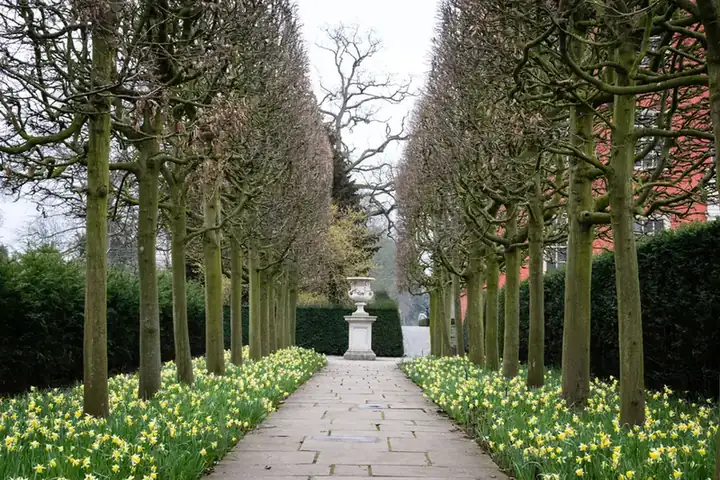
Pleached hornbeam, field-grown hedging and multi-stem trees arrive at real size. You choose the height you need for screening, and we source and plant it, so privacy does not depend on waiting several seasons.
Roses, hornbeam, Viburnum, Hydrangea paniculata, Persicaria, Rudbeckia and Miscanthus thrive in London Clay. We build schemes from plants that like the ground, rather than fighting it with soil swaps.
Compacted subsoil from the rebuild is broken up before planting. We dig or rip the beds, add organic matter and grit, and make sure roots have somewhere to go. Skip this and plants stall.
Clay sits wet all winter and cracks in a hot summer. We select plants that tolerate both, raise beds where waterlogging is severe and mulch to keep moisture steady through July and August.
A large new house needs big gestures: long runs of one hedge, generous blocks of planting, trees placed to frame elevations. Small scattered groups look lost against new architecture.
Many Radlett plots sit beneath protected oaks and hornbeams. We plan underplanting that suits their shade and roots, and keep new hedging clear of root zones where digging would cause damage.
Before You Choose
Ask what they will do to the soil before planting. On a rebuild plot the answer must include decompaction. Plants set into a slot cut in compacted clay behave like pot plants: water collects in the hole in winter and roots never leave it. You want a designer who digs test holes, talks about ripping or double-digging, and builds the preparation into the price.
Ask where they buy screening plants and how they are graded. Instant hedging and pleached trees vary hugely. You should be told the height, the clear stem, the root form - rootballed, container-grown or bare-root - and the nursery. Check the planting season too. Big rootballed stock is best moved in the dormant months, and a good designer will plan your programme around that.
Then find out how the garden will look on a grey February morning. Clay-loving perennials die back, and a garden made only of them is mud for three months. A proper Radlett scheme includes evergreen structure, clipped forms and winter stems, so the garden still looks designed when it is seen from the house in the dark months.
Compared
You can plant a clay garden quickly or cheaply. It is harder to do both. These are the routes we see most.
| Designed scheme with semi-mature stock | Young hedging left to grow | Builder's landscaping package | |
|---|---|---|---|
| Screening height | Specified to your sightlines, planted at size | Useful height after several seasons | Rarely included |
| Bed preparation | Decompacted, enriched and drained | Usually a slot in the clay | Turf removed, topsoil spread thinly |
| Plant choice | Clay-tolerant palette, tested soil | Hedging only | Generic shrubs from one supplier |
| Winter waterlogging | Raised beds or drainage where needed | Losses in wet hollows | Not addressed |
| Summer cracking | Mulched and irrigated for establishment | Gaps open up in drought | Lawn and beds both suffer |
| Look in year one | Established and in scale with the house | Thin and visibly new | Tidy but sparse |
Our Process
Your planting scheme follows our standard seven stages. Stock selection and ground preparation get most of the attention, because on Radlett clay they decide how fast the garden settles.
We walk the garden with you and listen more than we talk. Then the measuring starts: levels, orientation, drainage behaviour, existing trees worth keeping, and test pits to find out what soil you genuinely have rather than what the area is assumed to have.
A scaled masterplan showing the whole garden - spaces, routes, levels, structures and planting zones - with mood imagery for materials and atmosphere. This is where you react, argue and change things. Far cheaper to move a terrace on paper than in stone.
The agreed concept is developed into construction drawings and a species-by-species planting plan: setting-out dimensions, wall and step details, levels, lighting positions, and every plant named with its quantity and pot size.
Because the design is fully drawn, the build can be priced properly - each element itemised, so if the figure needs trimming you choose what changes rather than watching quality quietly disappear from everything.
Groundworks, drainage, terracing, walls, steps and structures, built off the drawings by our own landscaping team. Setting-out is checked against the plan, and sub-bases and falls are treated as the point of the job, not the boring bit before the paving.
Beds are decompacted and improved before a single plant goes in - on this area's clay-with-flints and chalk that preparation decides whether a border establishes or sulks. Then the planting plan is set out on the ground, adjusted by eye, and planted.
We walk the finished garden with you, hand over the plans, plant list and care calendar, and come back during the first season - because a designed garden is at its most vulnerable in its first year, not its first week.
Detail
Instant hedging is sold by the linear metre, at a chosen height. Pleached trees are sold by clear stem and frame size. Both arrive from the nursery ready to do their job. For a Radlett garden overlooked by a new extension next door, that is often the right spend: it buys privacy straight away instead of after several growing seasons of waiting. We visit growers, tag the stock and plan delivery for the dormant season, when big rootballs move best.
Screening only works if it sits in the right place, and the right place depends on terraces, paths and the lines of sight from where you sit. If the layout of the garden is changing too, our garden landscaping service in Radlett handles the groundwork and terraces after a rebuild. We design both together so the screens and the seating line up.
Reassurance
Budget
£4,000 – £20,000
Radlett planting commissions sit within this band. The biggest variable is screening: semi-mature hedging and pleached trees are priced by height and length, so how much instant privacy you want shapes the budget more than anything else.
Pleached hornbeam and field-grown hedging cost far more than young plants, and the price rises with height. We specify only as much as your sightlines need.
On plots along Loom Lane and Goodyers Avenue where construction traffic ran for months, beds need ripping, organic matter and sometimes imported topsoil. That labour is priced as its own line.
Around The Warren and Letchmore Heath, underplanting beneath mature oaks is hand work with smaller plants, done carefully around roots. It takes longer per square metre than open ground.
The Area
Three places worth knowing near Radlett. Each one says something about what grows well here.
The arts venue on Aldenham Avenue sits among established trees. Notice how much of the street's character is hornbeam and oak rather than architecture.
Learn more about The Radlett CentreParkland around a reservoir, with a rare-breeds farm. Wet margins and grassland show clearly which plants handle London Clay's winter water.
Learn more about Aldenham Country ParkIndependent shops in old farm buildings. The rural setting is a good reference for informal hedging and planting that suits Radlett's edges.
Learn more about Battlers Green FarmQuestions
Feedback
Rated 5 out of 5
“We had lived with a sloping, unusable lawn in Batchwood for eleven years and assumed it was just what the garden was. The masterplan split it into three levels with a long bench built into the top retaining wall, and we now eat outside from April to October. The bit that impressed me most was the drainage they insisted on putting behind the walls - invisible, and clearly the reason nothing has moved.”
Rated 5 out of 5
“The house was rebuilt two years ago and the garden never caught up - a builder's lawn and a patio that faced the wrong way. They redesigned the whole plot around the new kitchen's sightlines and put in planting with real maturity. Neighbours assume the garden came with the rebuild, which I think is the point.”
Rated 5 out of 5
“What we wanted was borders like the ones you see at proper gardens, and what we had was clay you could throw pots with. The planting plan came with every species named and a paragraph on why it would cope with our soil. Two summers in, the border is better than the photographs they showed us at concept stage.”
Rated 5 out of 5
“An outdoor kitchen was my husband's idea and I was sceptical it would ever be used. Because the gas, power and lighting all went in before the paving, it looks built-in rather than bolted on, and we cooked outside more or less every weekend last summer. The festoon lighting on the pergola was their suggestion and it makes the whole thing at night.”
Rated 5 out of 5
“A proper process from start to finish. Survey with test pits, a concept we pushed back on twice without any sulking, then a build crew who turned up when they said and swept the drive every evening. The care calendar they left us is pinned inside the shed door and actually gets used.”
Coverage
We plan and plant gardens in Radlett and across the wider area, including Watford, Rickmansworth and Chorleywood to the west and St Albans, Harpenden, Wheathampstead, Welwyn, Hemel Hempstead and Berkhamsted to the north.
Tell us where you are overlooked and what you want to see from the house. We will survey your Radlett garden and price the planting.